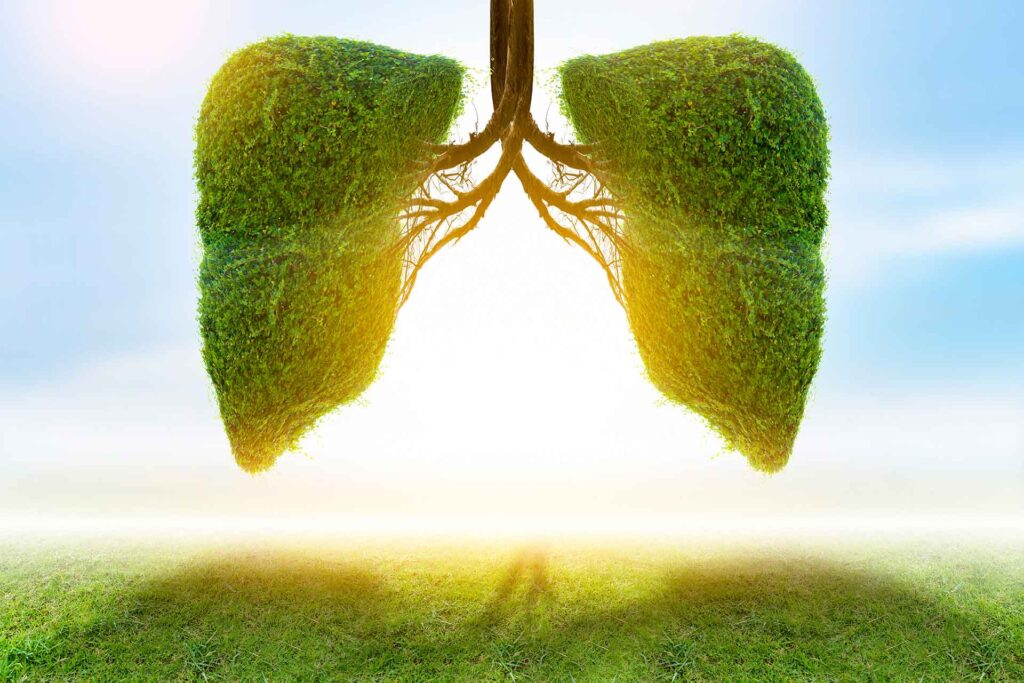
We tend to take breathing for granted and, as such, many of us may not be aware that it is an area of our health we can improve with simple movements and breath practices. Attending to lung health is more vital than ever in light of the current pandemic.
Essentially, breathing is a continual tidal rhythm which draws oxygen into the body with the inhalation and releases carbon dioxide (CO2) on the exhalation. This process occurs on a large scale through the lungs but also via cells located throughout the entire body as a part of cellular respiration.
Healthy lungs working optimally take in about half a litre of air roughly 12-15 times each minute. They then deliver oxygen to the cardiovascular system; every minute all the blood in the body passes through the lungs.
The lungs are frequently perceived as bags that fill with air. In reality, however, they are more like porous, elastic sea sponges in texture and their movement is often equated with the pulsing motion of a jellyfish.
The lungs are not muscles; they rely on the movement of the diaphragm (the upside-down bowl-shaped muscle at the bottom of the ribs). The diaphragm contracts and moves down towards the stomach to increase the volume of the chest cavity. This creates a partial vacuum, which draws air into the lungs. This action is supported by muscles between the ribs (external intercostals) contracting to allow the inside space to expand. The exhalation is the diaphragm releasing in an elastic recoil and drawing back up into the chest to push CO2 back out.
The four stages of breathing
Healthy breathing involves four stages:
1) Inhalation: the process of drawing in air; ideally this should be smooth and continuous.
2) Pause after inhalation: a cessation of the flow of air, leading to retention of the air in the lungs.
3) Exhalation: like inhalation, it should be smooth and continuous and not forced.
4) Pause after exhalation: this completes the cycle, which finishes as the pause ends and a new inhalation begins.
The importance of better breathing
In stressed breathing patterns the pause after exhalation is commonly interrupted because there is a tendency to draw in the next inhalation before the previous exhale has completed. This breathing pattern can be helpful when there is a need to stay motivated or to deal with danger as it can keep the body alert. It can, however, be very wearing as it uses up so much energy.
Stress-response breathing has a typical rate of around 18-25 breaths per minute. In comparison, resting breathing rate typically involves 8-12 breaths per minute. Faster breathing in response to stress is often referred to as “over-breathing” and is a low-grade form of hyperventilation. It can lead to both the creation of too much oxygen and exhalation of too much carbon dioxide.To allow a natural balance we need to come back to a slower, more relaxed form of breathing.
The brain demands up to 25 percent of the oxygen inhaled by the body. It follows, therefore, that concentration, focus and mental cognition can suffer if chronic stress leads to reduced breathing efficiency.
It is now well-accepted that breathing is the easiest and most direct way to positively affect the nervous system. Cultivating a smooth and steady calming exhalation forms a crucial component of mindful breathing practices within meditation. A recent research review identified a strong correlation between slow breathing and “psycho-physiological flexibility” proving that we are incredibly adaptable and resilient. Parasympathetic activity is clearly linked to emotional stability and psychological wellbeing.
It is better to breathe in through the nose as this produces Nitric oxide (NO) which opens up the cells in the lungs enabling them to receive oxygen and support bronchial tone (how well the airways in the respiratory tract contract and relax with breath).
NO also works body-wide to relax the inner muscles of the blood vessels, increasing blood flow and lowering blood pressure.
Better breathing means healthier lungs which provide a good insurance against respiratory problems. Obviously this is pretty important at the moment given the current COVID-19 challenge. Better breathing fosters naturally deeper regular breathing by increasing the elasticity of the lungs and rib cage and by supporting the protective lung microbiome (beneficial immune-supporting bacteria).
Increased oxygenation in the lungs may lead to improved elimination of toxins, sleep, recovery and immune function. As we age, lung cells contract meaning they can take in less oxygen. It is crucial, therefore, that we take steps to maximise our lung capacity.
Sadly, we lack the space in this article to describe specific breathing exercises but if you would like further advice then please contact us at Walnut Grove. We also run Pilates and Yoga classes which can help with your breathing. These classes are currently operating online due to lockdown restrictions.