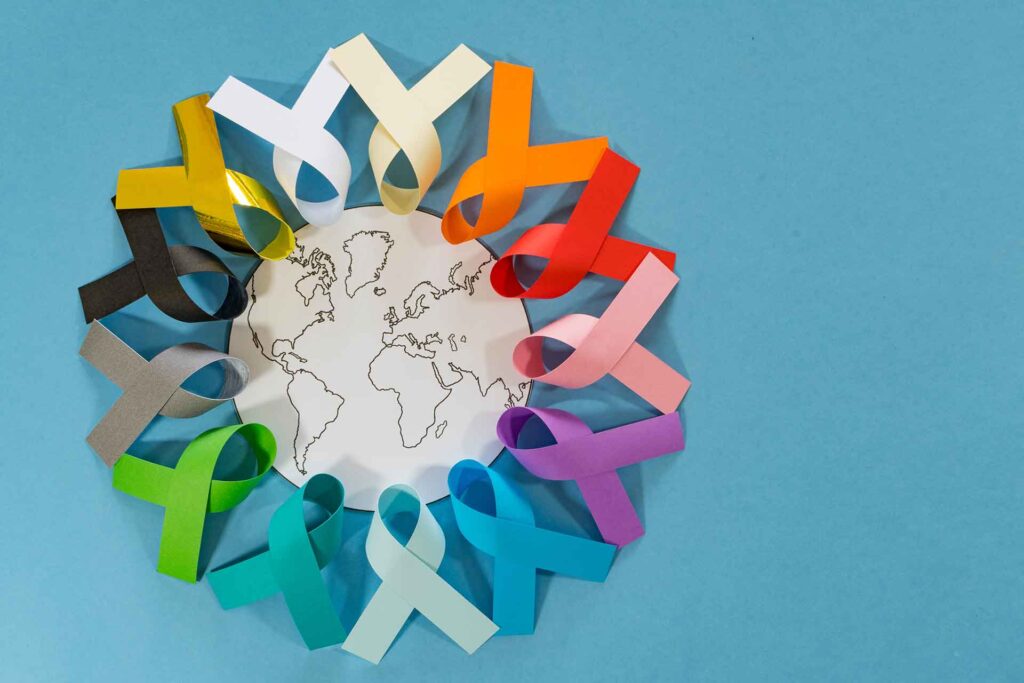
According to the World Health Organisation, cancer is a leading cause of death worldwide—nearly one in six deaths. With early detection and treatment, between 30-50% of cancer deaths can be prevented by modifying or avoiding risk factors and using evidence-based prevention strategies.
To support this important day, please have a look at some facts and figures below and explore our recommended resources at the end.
- 10 million people die from cancer every year.
- At least one third of common cancers are preventable.
- Cancer is the second-leading cause of death worldwide.
- 70% of cancer deaths occur in low-to-middle income countries.
- Millions of lives could be saved each year by implementing resource appropriate strategies for prevention, early detection and treatment.
- The total annual economic cost of cancer is estimated at US$1.16 trillion.
What is Cancer?
Cancer is a broad term. It describes the disease that results when cellular changes cause the uncontrolled growth and division of cells.
Some types of cancer cause rapid cell growth, while others cause cells to grow and divide at a slower rate.
Certain forms of cancer result in visible growths called tumours, while others, such as leukaemia, do not.
Most of the body’s cells have specific functions and fixed lifespans. While it may sound like a bad thing, cell death is part of a natural and beneficial phenomenon called apoptosis.
A cell receives instructions to die so that the body can replace it with a newer cell that functions better. Cancerous cells lack the components that instruct them to stop dividing and to die.
As a result, they build up in the body, using oxygen and nutrients that would usually nourish other cells. Cancerous cells can form tumours, impair the immune system and cause other changes that prevent the body from functioning regularly.
Cancerous cells may appear in one area, then spread via the lymphatic system. The lymphatic system is a system of specialised vessels and organs whose main function is to return the lymph from the tissues back into the bloodstream. The Lymphatic system is considered as a part of both the circulatory and immune systems
What are the causes of Cancer?
It’s difficult to pin down a cause and better to think of environmental risk factors possibly influencing an underlying genetic predisposition.
Modifiable risk factors include:
- Alcohol – The evidence that all types of alcoholic drinks are a cause of a number of cancers is now stronger than ever before. Alcohol can increase the risk of six types of cancers, including bowel (colorectal), breast, mouth, pharynx and larynx (mouth and throat), oesophageal, liver and stomach. The evidence suggests that in general, the more alcohol drinks people consume the higher the risk of many cancers, and that even moderate alcohol intake increases the risk of cancer.
- Being overweight or obese – excess weight has been linked to an increased risk of developing 12 different cancers, including bowl and pancreatic cancers. In general, greater weight gain, particularly as adults, is associated with greater cancer risks.
- Diet and nutrition – Experts suggest that diets and nutritional intake, particularly diets high in red meats, processed meats, salted foods and low in fruits and vegetables have an impact on cancer risks, particularly colorectum, nasopharynx and stomach.
- Physical activity – regular physical activity not only helps to reduce excess body fat and the cancer risks associated with this, but being physically active can help to reduce the risks of developing colon, breast and endometrial cancers.
- Tobacco – Tobacco smoke contains at least 80 different cancer-causing substances (carcinogenic agents). When smoke is inhaled the chemicals enter the lungs, pass into the bloodstream and are transported throughout the body. This is why smoking or chewing tobacco not only causes lung and mouth cancers but is also related to many other cancers. The more a person smokes, the younger they start, and the longer they keep smoking, all further increase the risk of cancer. Currently tobacco use is responsible for around 22% of cancer deaths.
- Ionising radiation – Man Made sources of radiation can cause cancer and are a risk for workers. These include radon, x-rays, gamma rays and other forms of high-energy radiation. Prolonged and unprotected exposure to ultraviolet radiations from the sun, sunlamps and tanning beds can also lead to melanoma and skin malignancies. Fair skinned people, individuals with a lot of moles or who have a family history of melanoma or non-melanoma skin cancer, are at highest risk. However, people of all skin tones can develop skin cancer, including individuals with darker skin.
- Workplace hazards – Some people risk being exposed to a cancer-causing substance because of the work that they do. For example, workers in the chemical dye industry have been found to have a higher incidence than normal of bladder cancer. Asbestos is a well-known workplace cause of cancer – particularly a cancer called mesothelioma, which most commonly affects the covering of the lungs.
- Infection – Infectious agents are responsible for around 2.2 million cancer deaths annually. This does not mean that these cancers can be caught like an infection; rather the virus can cause changes in cells that make them more likely to become cancerous. Around 70% of cervical cancers are caused by Human papillomavirus (HPV) infections, while liver cancer and Non-Hodgkin Lymphoma can be caused by the Hepatitis B and C virus, and lymphomas are linked to the Epstein-Barr virus. Bacterial infections have not been thought of as cancer-causing agents in the past, but more recent studies have shown that people who have helicobacter pylori infection of their stomach develop inflammation of the stomach lining, which increases the risk of stomach cancer.
Is there a genetic element to Cancer?
Genetic factors can contribute to the development of cancer.
A person’s genetic code tells their cells when to divide and expire. Changes in the genes can lead to faulty instructions, and cancer can result.
Genes also influence the cells’ production of proteins, and proteins carry many of the instructions for cellular growth and division.
Some genes change proteins that would usually repair damaged cells. This can lead to cancer. If a parent has these genes, they may pass on the altered instructions to their offspring.
Some genetic changes occur after birth, and factors such as smoking and sun exposure can increase the risk.
Other changes that can result in cancer take place in the chemical signals that determine how the body deploys, or “expresses” specific genes.
Finally, a person can inherit a predisposition for a type of cancer. A doctor may refer to this as having hereditary cancer syndrome. Inherited genetic mutations significantly contribute to the development of 5-10% of cancer cases.
What treatments are available?
Innovative research has fuelled the development of new medications and treatment technologies.
There are side effects of treatments such as hair loss however advances in treatment are improving the outlook for people with cancer.
Doctors usually prescribe treatments based on the type of cancer, its stage at diagnosis, and the person’s overall health.
Below are examples of approaches to cancer treatment:
- Chemotherapy aims to kill cancerous cells with medications that target rapidly dividing cells. The drugs can also help shrink tumours, but the side effects can be severe.
- Hormone therapy involves taking medications that change how certain hormones work or interfere with the body’s ability to produce them. When hormones play a significant role, as with prostate and breast cancers, this is a common approach.
- Immunotherapy uses medications and other treatments to boost the immune system and encourage it to fight cancerous cells. Two examples of these treatments are checkpoint inhibitors and adoptive cell transfer.
- Precision medicine, or personalised medicine, is a newer, developing approach. It involves using genetic testing to determine the best treatments for a person’s particular presentation of cancer. Researchers have yet to show that it can effectively treat all types of cancer, however.
- Radiation therapy uses high-dose radiation to kill cancerous cells. Also, a doctor may recommend using radiation to shrink a tumour before surgery or reduce tumour-related symptoms.
- Stem cell transplant can be especially beneficial for people with blood-related cancers, such as leukaemia or lymphoma. It involves removing cells, such as red or white blood cells, that chemotherapy or radiation has destroyed. Lab technicians then strengthen the cells and put them back into the body.
- Surgery is often a part of a treatment plan when a person has a cancerous tumour. Also, a surgeon may remove lymph nodes to reduce or prevent the disease’s spread.
- Targeted therapies perform functions within cancerous cells to prevent them from multiplying. They can also boost the immune system. Two examples of these therapies are small-molecule drugs and monoclonal antibodies.
Doctors will often employ more than one type of treatment to maximise effectiveness.
What can we do to help at Walnut Grove?
We have practitioners who can help manage the mental and physical challenges of treatment from Dr Tong and traditional Chinese medicine and acupuncture, Kate Oldham who is a cancer rehabilitation specialist and Trish Barton, psychotherapist.
Kate is a new member of the Walnut Grove family and has written the following to give you some encouragement to ask for help when it’s needed.
Cancer is an individual journey. It can throw so many challenges our way, physically, mentally and spiritually. From diagnosis to treatment and post treatment, there are many times that we require help and support. After effects from diagnosis through treatment and beyond, have an impact on us mentally and physically. It can affect how we feel about ourselves and be a block from us moving forward. I know, I’ve been there! Whether you are going through treatment or are post treatment, I can support you. With 10 years of training and experience under my belt, and two years of my own cancer treatment and follow up, I have full empathy with what you or your loved one is going through. How can I help? I provide a range of therapies that you can choose from that will support you. Giving you control over your wellbeing.
Lymphoedema Management Service
The lymphatic system has always fascinated me. I feel it is an underrated but essential part of our bodily systems. There are a range of ways to support your lymph system and lots of techniques to learn on how to self-manage lymphoedema at home.
People can be affected by Primary Lymphoedema or Secondary Lymphoedema. More commonly I deal with Secondary Lymphoedema where cancer treatments or surgery have been the causal factor.
Therapies that can support you:
- ScarWork
- Lymphoedema
- NeuroMuscular Release
- Reflexology
- Myofascial Release
- Reiki
- Hypnotherapy/Relaxation
- Physical Therapy Advice
In addition – I have a connection with Stephen Gamble who with his wife runs a charity in Leicestershire – membership is free for those with a cancer diagnosis and it is a great community both online (as we are not so close in the SW) and in person for those who live nearby. Here is the website – it’s a great place to go, to look at alternative interventions that may help your personal journey:
https://www.togetheragainstcancer.org.uk/