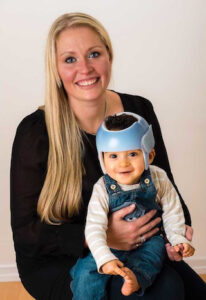
The Term Plagiocephaly is a blanket word for covering three different types of flattening on a child’s head.
The three different types are:
- Plagiocephaly,
- Brachycephaly,
- Scaphocephaly.
All three terms describe the flattening of different areas of a child’s head. Brachycephaly and Plagiocephaly are the most common, however, it is not uncommon for a child to have both Plagiocephaly and Brachycephaly together.
Plagiocephaly:
Plagiocephaly describes the flattening on one side of the child’s head. This type of flattening is commonly associated with a parallelogram-shaped head, a shift forward of the ear and a more prominent forehead on the same side as the flattening and possibly the eyes appearing to have unequal positioning.
Brachycephaly:
Brachycephaly describes a flattening across the back of a child’s head. This type of flattening is commonly associated with a loss of definition of the neckline, a wide head shape, prominent bony lumps above the ears, a bossed/protruding forehead and possibly an excessively high height of the head.
Scaphocephaly:
Scaphocephaly is the rarest of the three. It describes a flattening on both sides of a child’s head, giving the overall impression of a long narrow head shape and is associated with an overly exaggerated neckline.
What causes Plagiocephaly?
The flattening occurs due to an external force exerted onto the child’s head for a prolonged period. Due to the soft, malleable, mobile characteristics a child’s skull has, the external force, when left in contact for a length of time, can cause a flattening in the corresponding area.
What are the external factors which influence Plagiocephaly?
There are several external factors which can cause Plagiocephaly. These could be:
- The position of the baby in the womb.
- Restricted space in the mother’s womb,
- Multi foetuses / Twins,
- How long the baby was engaged,
- Extended time in a neonatal unit,
- The child’s preferred sleeping position,
- Torticollis (Tightness/contraction of the neck muscles (Sternocleidomastoid)).
What is the incidence of Plagiocephaly?
Statistics show that in 1992 the incidence of Plagiocephaly was approximately 1 in 300, compared with 1999 where the incidence had increased to approximately 1 in 60 children. Therefore in the United Kingdom in 2009, there were 706,248 babies born, of which in line with the statistics, 11,770 babies had a form of deformational plagiocephaly.
Why has the number of babies diagnosed with plagiocephaly increased?
Plagiocephaly is more common than it used to be. Before 1992 babies were put to sleep in every position, including on their tummies. This varied the amount of force exerted onto all areas of the child’s head. The ‘Back to Sleep’ program was introduced in 1992 to reduce Sudden Infant Death Syndrome (SIDS). The back-to-sleep program advised that all babies should be placed on their backs when going to sleep until the individual child can roll and reposition themselves independently. However, this allowed the force exerted onto the child’s head to be concentrated to a smaller area, increasing the risk of Plagiocephaly. A direct correlation was seen from the reduction of SIDS to the increase in the number of babies with Plagiocephaly. The Back to Sleep program has been very successful in reducing the incidence of SIDS, so it is vital to continue following the advice of placing your child on their back to sleep. Due to this, it is very important to increase the time a baby spends on their tummy during the day while the child is supervised and awake, to lessen the risk of Plagiocephaly.
What is Torticollis?
Torticollis is another factor which can predispose a child to a flattening on their head. It is characterised by tightness and shortening in sternocleidomastoid and other neck muscles. When one side of this muscle is shortened or contracted the child’s head will flex forward, tilt towards the affected shoulder and the child’s head will rotate towards the opposite shoulder. This limits normal range of movement therefore only allowing the child’s head to rest in one position, so any external force is concentrated in one area causing Plagiocephaly.
It is estimated that approximately 85% of children diagnosed with Plagiocephaly have a form of Torticollis.
How Can Plagiocephaly Be Corrected?
Early detection and diagnosis play a vital role in the management and treatment of Plagiocephaly. It is crucial to understand and recognise the factors influencing the flattening so to be able to reduce them to slow down and hopefully halt the progression of Plagiocephaly.
If a child is less than 4 months old, Align Clinics recommends a free assessment with our specialist to measure and record the head shape at present. Our highly trained Clinician discusses and advises all repositioning techniques including an increase in tummy time. As specific measurements would have been taken, further assessments are recommended monthly to record the child’s growth and degree of Plagiocephaly over time, so any increase or decrease can be objectively recorded, and if needed further treatment can commence at the earliest and most effective time.
If an improvement hasn’t been observed by the time the child is 5 months old. Align Clinics recommends that parents or guardians consider the helmet treatment.
If your child is 4 months old or older, Align Clinics recommends a free consultation to observe and measure the degree of Plagiocephaly and advise on the best course of treatment from these results.
What is Helmet Treatment?
The cranial remoulding orthosis (band/helmet) redirects normal head growth to improve normal proportions and symmetry of your child’s head.
The helmets are custom orthoses designed individually for each child to provide total contact over the prominent or bossed areas of the child’s head with voided areas correctly placed corresponding to the flattened areas. The total contact area discourages growth and the voided areas encourage and allow all growth. Therefore the helmet functions by directly channelling the child’s head growth into the flattened areas, creating symmetry and normal length.
The helmets are constantly altered and modified throughout treatment by the specialist at AlignClinics. The alterations correspond directly to the child’s head growth to continually maximise improvement within the shortest time.
What is the History of Cranial Remoulding Orthoses?
Young children have been treated for Plagiocephaly using helmets since the 1970s. Dr. Clarren, Dr Smith and Dr Hansen in 1979 wrote the first article about the use of cranial remoulding orthoses to treat deformational plagiocephaly.
Since 2005 over 100,000 children have benefited from cranial remoulding orthoses.
What is the ideal age for helmet treatment?
The most effective age range to start treatment is between four and seven months. At this time the child will have head control and the child’s skull will be growing at the fastest rate.
Cranial remoulding can be successful from the age of three to eighteen months of age.
Why is treatment more effective between 4 and 7 months than at other ages?
The first 3 months of life is when the skull grows the quickest, however, this time is more beneficially spent repositioning to encourage symmetry and prevent any flattening from occurring. At approximately 4 months of age, a child will develop better head control and will be able to tolerate the additional 5-6 ounces of weight from the helmet. At this age, the head grows approximately 10mm per month. This growth can be channelled within the helmet in a controlled direction to create symmetry.
Between 8 and 12 months, although the skull is still growing, the rate slightly reduces to approximately 5mm per month. Between 13 and 18 months the rate reduced further to below 5mm per month.
As a child increases in age, the bone density increases and the malleability and mobility of the skull bones decreases, this also slows down the rate of improvement of the treatment. Although growth still occurs at 13 months onwards, treatment is still effective, but the child may be in treatment for a longer period to achieve optimal results.